 Tiffany To
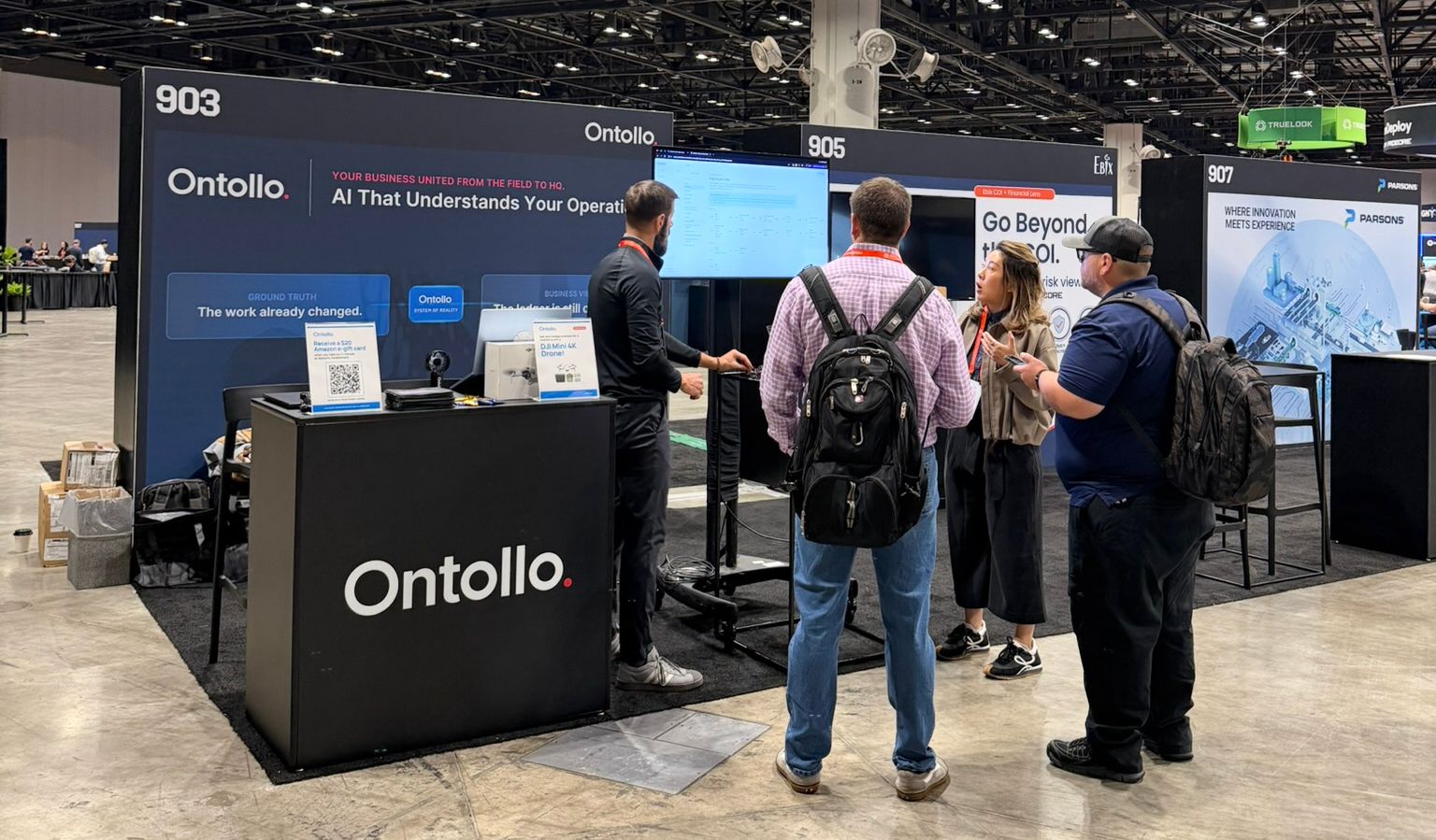
Builders want AI they can trust: Insights from Groundbreak 26
Last week, thousands of GCs, specialty contractors, and owners arrived in Orlando for Groundbreak 26 with one topic top of mind: AI. More than just...
Microsoft recently published a candid account of what it learned from its own AI transformation. One line stuck with me: "Access and usage do not equal transformation." A tool licensed to more than 200,000 people, they wrote, does not by itself change how the work gets done.
I keep coming back to that line, because we see the same pattern every week in a very different setting.
Ontollo works with operators in construction, energy, infrastructure and healthcare operations. These are companies that run job sites, substations, fleets and plants and coordinate sophisticated human resource allocation to patients. They have bought the licenses. Their teams are curious and willing. They've been experimenting but the results are very mixed, and sometimes laughable. One construction client shared an anecdote with us about designing a face shield with AI and the LLM's suggestion to use plastic. Their field teams are in sweaty, muddy environments so they quickly tossed the shield and their Supervisor came up with a mesh option that fit their needs.
That isn't because the models are weaker at physical work. It's because AI needs context. A better prompt can help, but in dynamic operations environments AI shouldn't have to rely on each person being detailed about their prompt. What they and their whole organization needs is a current, connected picture of what is actually happening: the environment, the business and the operators themselves. For most operators, that picture lives across five systems that were never designed to talk to each other, plus whatever the superintendent saw this morning.
Here is what we've learned building that picture alongside our customers.
Microsoft's first lesson was to start with the business outcome rather than the technology. In physical operations, the outcome almost always arrives as a question. And the questions that matter most share one property: no single system can answer them.
Here's an example:
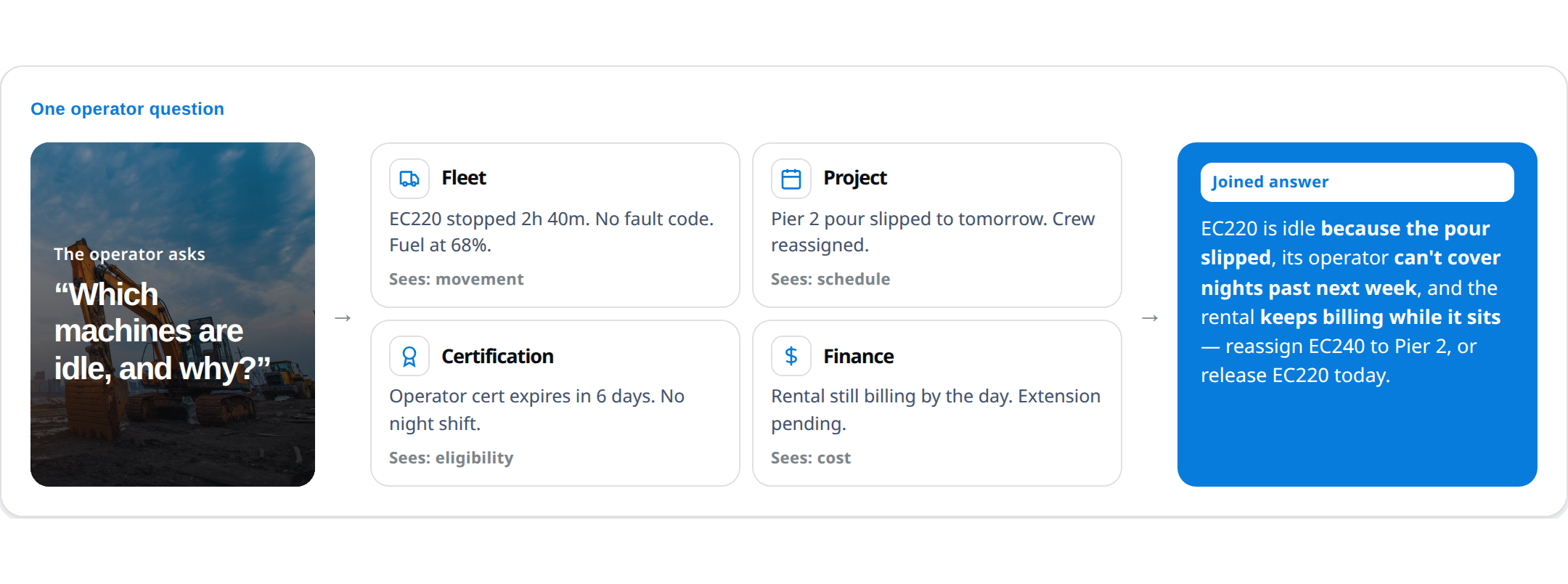
"Which of our owned, idle machines can replace the hire on Stage 2, and do we have a certified operator near the site?"
Four systems each hold a piece. The fleet system knows which machines exist and where they sit idle. The project system knows what Stage 2 needs and by when. The certification system knows who holds the right ticket and where they're based. Finance knows what the external hire costs. Every one of them is correct. None of them can answer alone.
This isn't hypothetical for us. One of our customers, an energy infrastructure platform in Australia scaling past $1B in revenue across more than fifteen disconnected systems, was renting equipment externally while identical assets sat idle elsewhere in the group. Leadership knew the margin was leaking and couldn't locate it. Working with their leadership team, including their CFO, we validated between $8M and $19M a year in avoidable cost. That engagement is now a paid production rollout.
The lesson: inventory the questions before inventorying the tools. Wherever an important answer crosses a system boundary, that boundary is where the value is hiding.
The natural first move is to point an AI assistant at the systems of record and let it search. That can be genuinely useful. It summarizes, drafts and finds documents, and it saves real hours.
But it also inherits each record's blind spot. A record stores what it was told, not whether what it was told is still true. A project board that stopped being updated three weeks ago looks exactly as confident on day twenty-one as it did on day one. When the Navigant Construction Forum studied 1,362 projects and more than a million requests for information, it found that more than one in five never received an answer at all. Every one of those items sat in a system that knew it existed, with a date and a status. None of them could signal that it was holding up a crew.
Retrieval exposes this limitation. A retrieval-based assistant pulls back a handful of the most relevant-looking snippets and reasons over them. That works for a lookup. It breaks on questions that need facts from several places to line up. In the MultiHop-RAG benchmark, even GPT-4 answered cross-document questions correctly only 56% of the time when working from retrieved chunks, against 89% when handed the right evidence directly.
More importantly, the stakes change by industry. Take an energy utility asking:
"Which spare transformers can go to the Eastfield substation upgrade, and is the crew's switching authorization still current for that voltage class?"
Retrieval reliably finds the transformer spec sheet. It rarely finds the link between a person's authorization and a voltage class, because that link doesn't live in any single document. An expired authorization that still surfaces in a snippet from an old training record is not a cost problem. That's a significant safety problem.
As every business races to enable their teams to leverage AI, after turning on the tools, they arrive at the realization that they need to figure out how to pump the right context into these tools. Many start reasonably by connecting their systems to the tools.
"Our system of record vendors are shipping MCP servers. Won't that solve it?"
Yes, and no. A system of record MCP server gives an AI model clean, structured access to one system through real function calls. For a lookup or a count inside that system, it's a genuine step up from searching documents.
The trouble starts the moment a question crosses a system boundary, which in practice is most of the questions operators actually ask. Three things are still missing:
No cross-system joins. Each server knows its own system. The model still has to stitch the answer together live, inside its context window, every single time.
No identity resolution. The ERP calls a unit EQ-04. The maintenance log calls it "Volvo EC220 number 4." Finance has it under an asset tag. Nothing about querying three separate servers tells the model those are the same machine.
No persisted business rules. Ask whether EQ-04 is overdue for service, and no system can simply answer because "overdue" isn't a field anywhere. It's a rule: this machine is due every 250 engine hours, the hours it has run come from telematics, and the last service date lives in the maintenance log. A connector can hand the model each of those raw numbers, but the model still has to work out the rule and do the math itself, every time someone asks. Ask on Monday and again on Thursday, or ask two different ways, and it may not apply the rule the same way twice. But if defined once in a context layer, "overdue" means the same thing in every answer, and someone in the business can review and approve that definition.
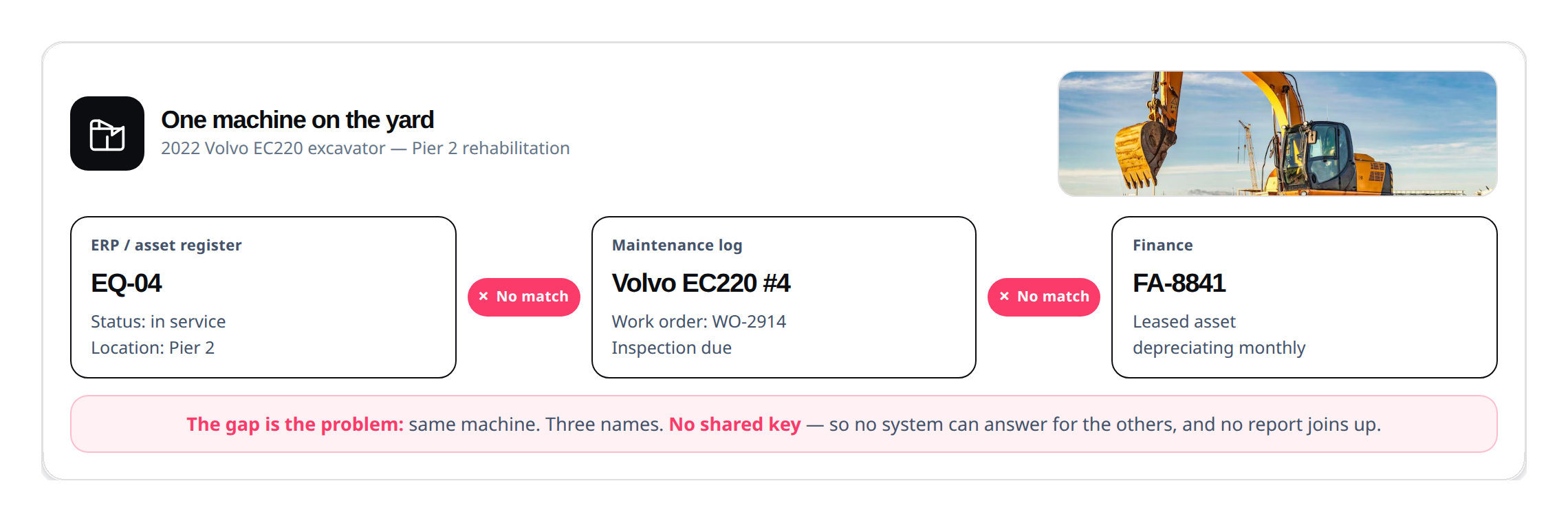
Connectors give AI cleaner ingredients. They don't give it the recipe. Someone still has to decide how the pieces fit together, what counts as the same machine, and what "overdue" means for this business. That isn't a knock on connectors. A vendor's MCP server is a great way to feed information into a context layer, and a business that has already connected three systems is further along than it thinks. But the connections are where the work starts, not where it ends.
This is the lesson I feel most strongly about, and it has shaped how my co-founder and I have thought about the architecture of our solution at Ontollo.
The layer that fixes the first three problems has a formal name: an ontology. In plain terms, it's the agreed definition of the things an operation runs on and how they connect. What counts as a job, a commitment, a crew, an asset, a delay. Which depends on which. What a change in one implies for the rest.
Stored as an operational knowledge graph, it lets an answer be assembled from connected facts rather than retrieved from whichever export happened to be nearby, and every fact carries its source.
The tempting assumption is that the major platform vendors will build this, and eighteen months of patience solves it. Having built one of these layers before for one of these platforms to serve several hundred thousand customers, our experience is that this isn't primarily a technical problem. The definitions are specific to how a business operates. Not just use case and industry specific but even at the company level.
A self-perform contractor and a construction manager at risk do not share a model of how their work connects. Neither do a utility and an infrastructure owner. None of them has the one that ships in the box.
Every system of record models its own world, and that's exactly what it should do. Procurement platforms model procurement well. Project platforms model projects well. But the sentence that matters to an executive lives between those worlds: this invoice belongs to that commitment, under that cost code, on that job, worked by that crew, against that activity, and here is what it does to the number we bid.
No single vendor sits in a position to own that sentence, and no operator should want one to. I won't insert any Alex Karp videos here, but suffice it to say that we're aligned at Ontollo that the know-how of a business should belong to them.
There's a durability argument too. Definitions outlive systems. When a procurement platform gets replaced, the fact that a commitment belongs to a job doesn't change. Only the source underneath it does. Organizations that wire systems directly to one another pay for every replacement in integration work. Organizations that define meaning above their systems pay for it in a connector.
The same logic explains why a digital twin doesn't close this gap on its own. A twin models the asset. A graph models the work: who, what, where, and against which commitment. Operators need both, and only one of them answers the Stage 2 question.
The question every leadership team should be asking itself is simple.
"If we change platforms in three years, does the model of how our work connects come with us?"
Microsoft put it well: "Efficiency is the floor; capability is the ceiling." But in physical operations, we'd say the ceiling is timely decisions.
Start with the floor, because finance sponsors care about it. A context layer sets the floor on what AI costs to run. An agent that already knows how a piece of work connects doesn't have to reconstruct the organization on every request. Without that layer, it pays to re-derive the same context over and over. Effective use of ontologies with AI can reduce token counts by 89%.
Our own worked examples across construction, energy and logistics show the shape of it (illustrative, and always worth benchmarking on real data). Dumping raw records into a prompt gets more expensive every time a system or a quarter of history is added. Retrieval stays cheap, but for the wrong reason: it reads a fixed-size sample, so as the data grows its cost holds steady while its odds of finding the right facts quietly fall. A graph-grounded answer stays flat for the right reason. It scales with the size of the answer, not the size of the operation, so a logistics fleet with five to ten times more telematics data than a construction site costs about the same to ask.
Then the ceiling. In physical operations, the most expensive problem usually isn't a wrong number. It's a right number that arrives after the decision it should have changed.
Most contractors know the pattern. Materials post to the ledger within a day or two. Subcontractor invoices can take weeks, sometimes months. Labor hours land against the job, but not against the activity the crew was actually doing. So on any given day, the cost picture finance sees is missing a real share of what has already been committed, and nothing in the ledger says so.
Picture a project manager whose foundation work is running ahead of the quantities the field logs each day. The overrun is real, but most of it sits in invoices that haven't posted yet. By the time it shows up in the job cost report, the work is in the ground, the forecast has moved, and the contract's notice window may already have closed. The report is accurate. It's also too late to change anything.
Now picture the same project manager seeing that gap in week two instead of at month end. The list of things she can still do is long:
None of those decisions is hard. Each one has a short shelf life. Today, most of them expire before anyone has the full picture, because a person has to put it together by hand, usually at month end, usually under pressure.
The ceiling is closing that gap. When a business has a current, connected picture of its own work, joining what the field logged, what procurement approved and what has actually posted, the finding arrives while there's still a decision to make. It arrives as a task, routed to the person who can act, with the evidence attached. Nothing changes in a source system until that person confirms it. The system does the typing. The operator keeps the call.
Efficiency gives people back hours. Better decisions give them back the margin.
Microsoft closed with practical recipes. Here's ours, shaped by what has worked with our customers.
That's the shape of the 30-day pilot we run at no cost when there's a fit: systems mapped in week one, two or three sources connected in week two, real scenarios tested in week three, and a written findings report in dollars plus a working proof of concept in week four.
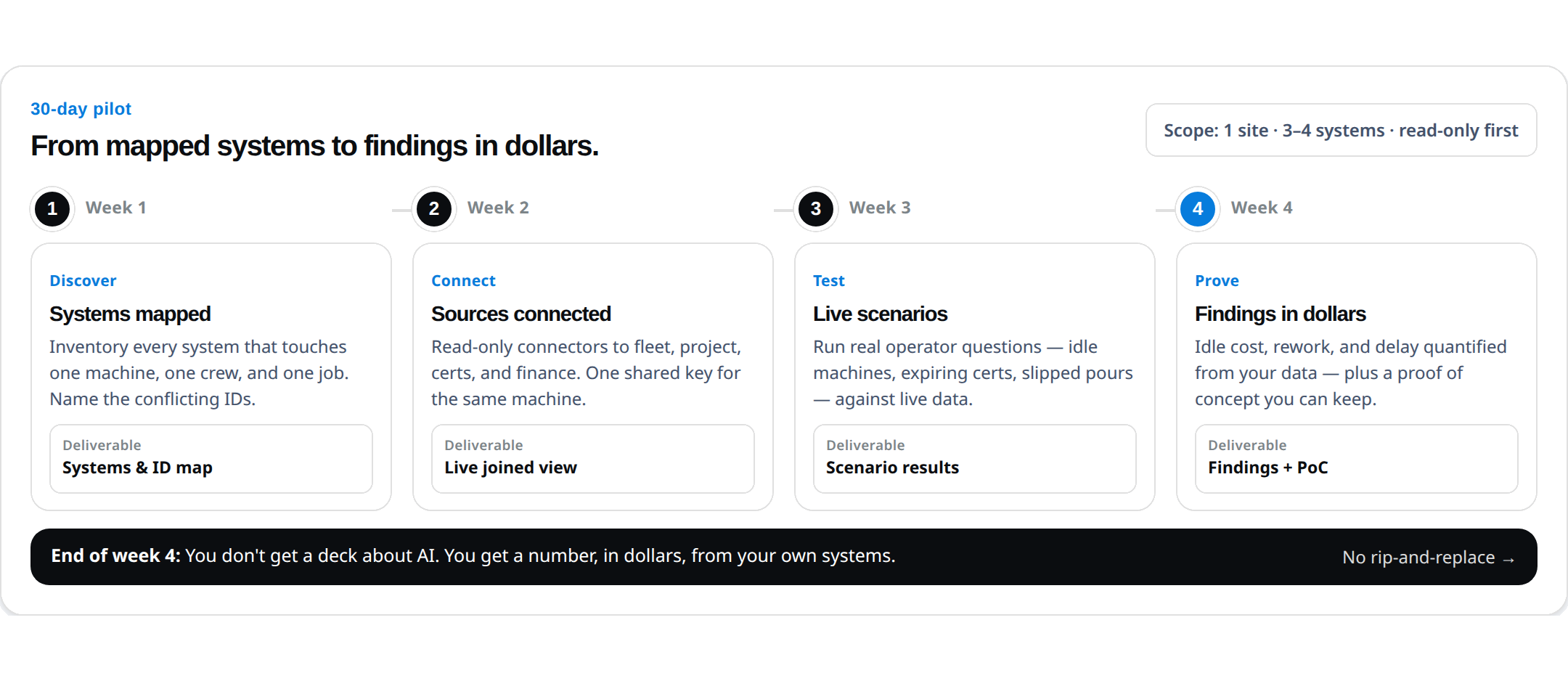
The organizations that get real value from AI won't be the ones running the most agents. They'll be the ones holding a current, connected picture of their own work, in a form they can take with them.
If you're wrestling with the same gap, I'd love to compare notes. Book a demo, or check out our white paper, The Operations Leader's Guide to AI in Industries that Build and Run the World.
Last week, thousands of GCs, specialty contractors, and owners arrived in Orlando for Groundbreak 26 with one topic top of mind: AI. More than just...
I've walked the halls of the Venetian in Las Vegas more times than I can count, mostly for cybersecurity conferences, so I arrived at AU 2026 last...
With companies racking up AI bills for their experiments, the conversation has decidedly shifted to measuring outcomes. Boards ask about them, pilot...